Canara Engineering College
Approved by AICTE, Affiliated to VTU
Approved by AICTE, Affiliated to VTU
The Department of Electronics and Communication Engineering strives to be a centre of repute by imparting quality education to produce globally competent graduates with human values.
Electronics and Communication Engineering (ECE) is a dynamic field which encompasses the acquisition, communication, manipulation, and analysis of Information/Signals. This discipline spans a wide range of applications from everyday electronics to complex systems used in industries, medical devices, and beyond. EC has experienced rapid technological growth, and its impact is evident across numerous domains of engineering.
The comprehensive curriculum of ECE provides students with abundant career opportunities, not only in Electronics and Communication but also in allied fields such as Instrumentation, Computer Engineering, Aeronautics, Mechatronics, and Biomedical Engineering. Our faculty members are highly experienced and dedicated to guiding students toward successful careers, advanced studies, and research activities. They have contributed significantly to international journals and attended numerous professional development workshops.
The Department of ECE at Canara Engineering College is committed in providing state-of-the-art infrastructure with cutting-edge equipment and software tools, supported by dedicated technical staff. The department has well-equipped laboratories, including those for research and industrial projects, and maintains a close interaction with alumni to continuously enhance our curriculum and technical activities. We conduct numerous core technical workshops, expert lectures, industrial visits, and internship programs to keep our students updated with industry needs and trends.
Our commitment is to provide quality education through innovative teaching and learning processes, modern facilities, and a supportive academic environment.
Some of the Key Practices of Department Include
"The roots below the earth claim no rewards for making the branches fruitful."- Rabindranath Tagore
Welcome to the department of Electronics & Communication Engineering at Canara Engineering
College. The Department was established in the year 2001 with the aim of providing leadership in
the field of Electronics & Communication Engineering. This department has been accredited twice
at 2015 and 2019 by National Board of accreditation.
Our mission is to develop innovative teaching and learning pedagogies to help the students to
conquer new frontiers. Students are trained to work in multidisciplinary teams and motivates both
co-curricular and extracurricular activities, for the overall development of its students. The
department encourages the students to actively carry out their projects across various areas of
Electronics and Communication and to develop their technical and research skills by attending
various workshops, conferences, competitions, etc. We have a team of well qualified, experienced,
and committed staff members. The Department of ECE has a unique blend of quality conscious
staff members with a strong sense of ethical and professional responsibility.
The department has excellent lab facilities which are being upgraded from time to time with
cutting edge technology tools. Equal importance is given to both hardware and software labs.
The department organizes several technical and nontechnical events to prepare the
students to fit into industries. The department has several MOU with industries with their help,
several activities are conducted for the overall department of students as well as faculty.
Our alumni are the backbone of our department. They help the students for the placements and in
upgradation of their technical knowledge.
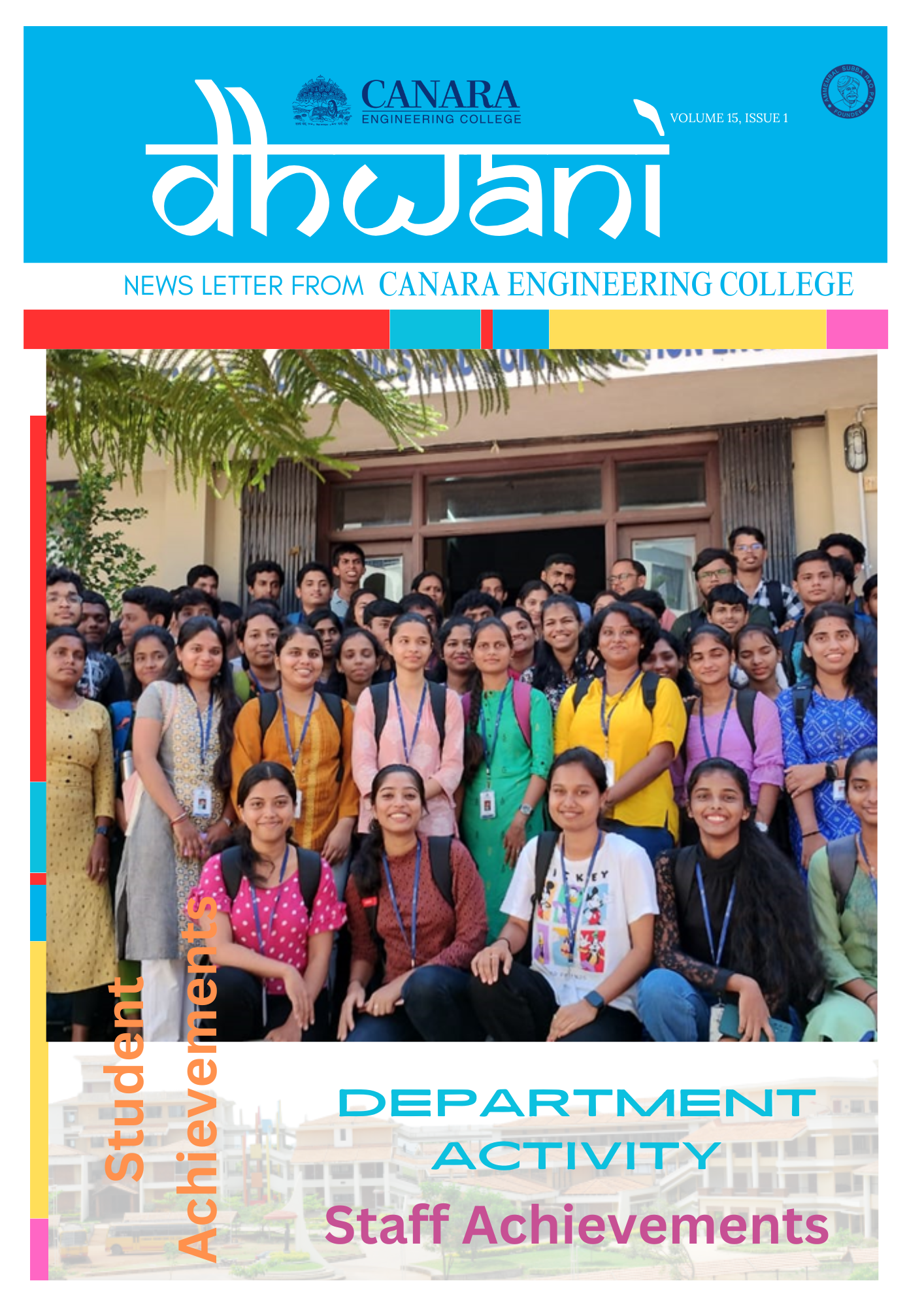
Department brings Newsletter "Dhwani" twice in a year. All the lectures of the subjects are
available on college YouTube channel.
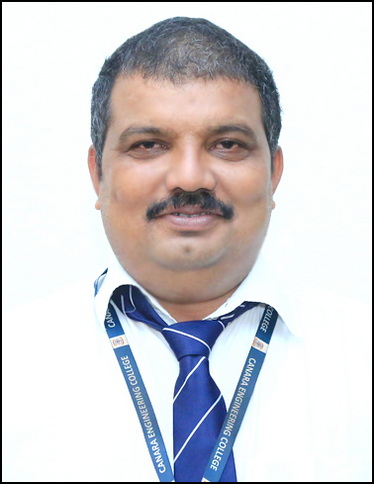
-Dr.Raghavendra M Shetty K
Head of the Department
Established in 2001, the Department of Electronics and Communication Engineering is affiliated with Visvesvaraya Technological University (VTU), Belagavi, Karnataka. The department is approved by the All India Council for Technical Education (AICTE) for its undergraduate program and is accredited by the National Board of Accreditation (NBA) until July 2025. Committed to imparting quality education, the department aims to nurture students to meet the evolving needs of the industry.
Faculty and Research
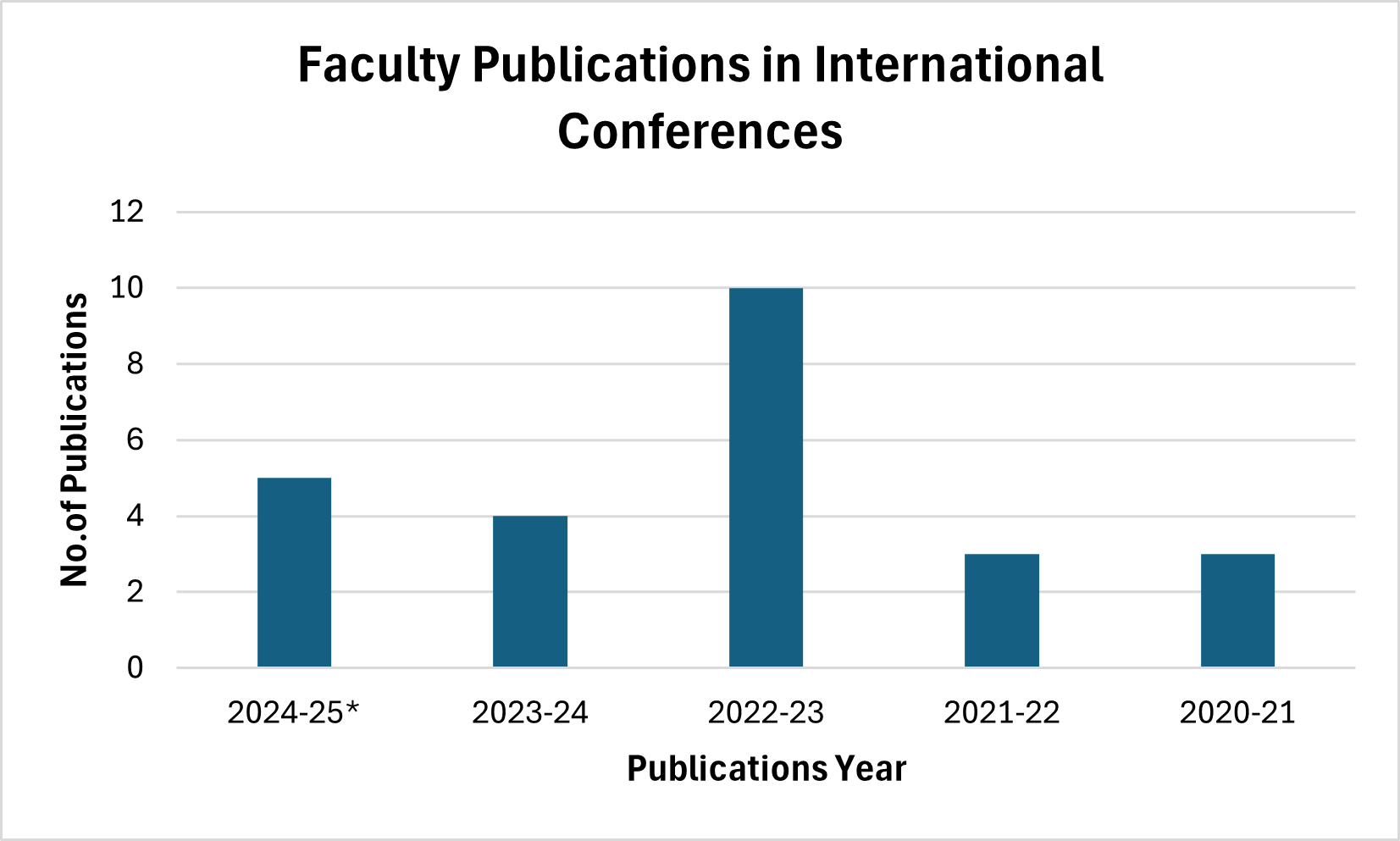
The department boasts a team of highly qualified and experienced faculty members, maintaining an excellent student-to-faculty ratio of 16:1. Among them, three hold doctoral degrees, nine are pursuing Ph.D.s, and the rest are postgraduates. Faculty members are actively engaged in research, contributing to national and international journals, and presenting papers at renowned conferences. They regularly participate in Faculty Development Programs (FDPs) and technical workshops to stay updated with the latest advancements in the field.
Student Development and Industry Exposure
Students are provided with ample opportunities to work on mini-projects, enhance their communication skills, and secure internships with industry partners. They are encouraged to enroll in continuous learning programs such as Spoken Tutorial and NPTEL. The Institution’s Innovation Council (IIC) organizes guest lectures, industry expert talks, and industrial visits to bridge the gap between academia and industry. Additionally, the department also conducts various co-curricular and extracurricular activities to promote holistic development.
A well-established mentor-mentee system ensures personalized guidance, helping students excel in academics and participate in essential career-building activities.
Outcome-Based Education and Research
Following an Outcome-Based Education (OBE) framework, the department emphasizes hands-on learning through technical activities, mini-projects, and product development initiatives. Research activities are actively promoted, with students and faculty encouraged to present papers at technical fests and conferences. The department has Memorandums of Understanding (MoUs) with leading industry partners, including Kakunje Software Pvt. Ltd. and GTTC Mangalore, to facilitate collaborative learning and research.
The curriculum is designed to provide a strong foundation in fundamental principles while integrating advancements in various domains such as embedded systems, digital communication, signal processing, VLSI, and microprocessors. Additionally, significant emphasis is placed on enhancing students’ coding skills to expand their career opportunities in the IT industry. Training in IT-related skills is provided by QSpiders, Bangalore, while Ethnus offers specialized soft skills training.
Bridging the Curriculum Gap with Add-On Courses
To further enhance students' technical expertise and bridge gaps in the curriculum, the department offers various add-on courses. These courses equip students with practical knowledge and industry-relevant skills in:
Preparing Students for a Competitive World The department is dedicated to shaping well-rounded professionals who are industry-ready and equipped to thrive in the competitive global landscape. By fostering technical expertise, research capabilities, and essential soft skills, we ensure that our students are well-prepared for successful careers in both core engineering and IT sectors.
Engineering graduates in Electronics and Communication Engineering will be able to:
The Department of Electronics and Communication Engineering is equipped with totally 6 full-fledged laboratories. All the laboratories are fully equipped to meet all the requirements of the curriculum and have good ambience and ventilation.
This laboratory enables the 4thyear students to gain practical experience in understanding the digital modulation techniques, microstrip antennas, and optical communication systems.
Major facilities
| 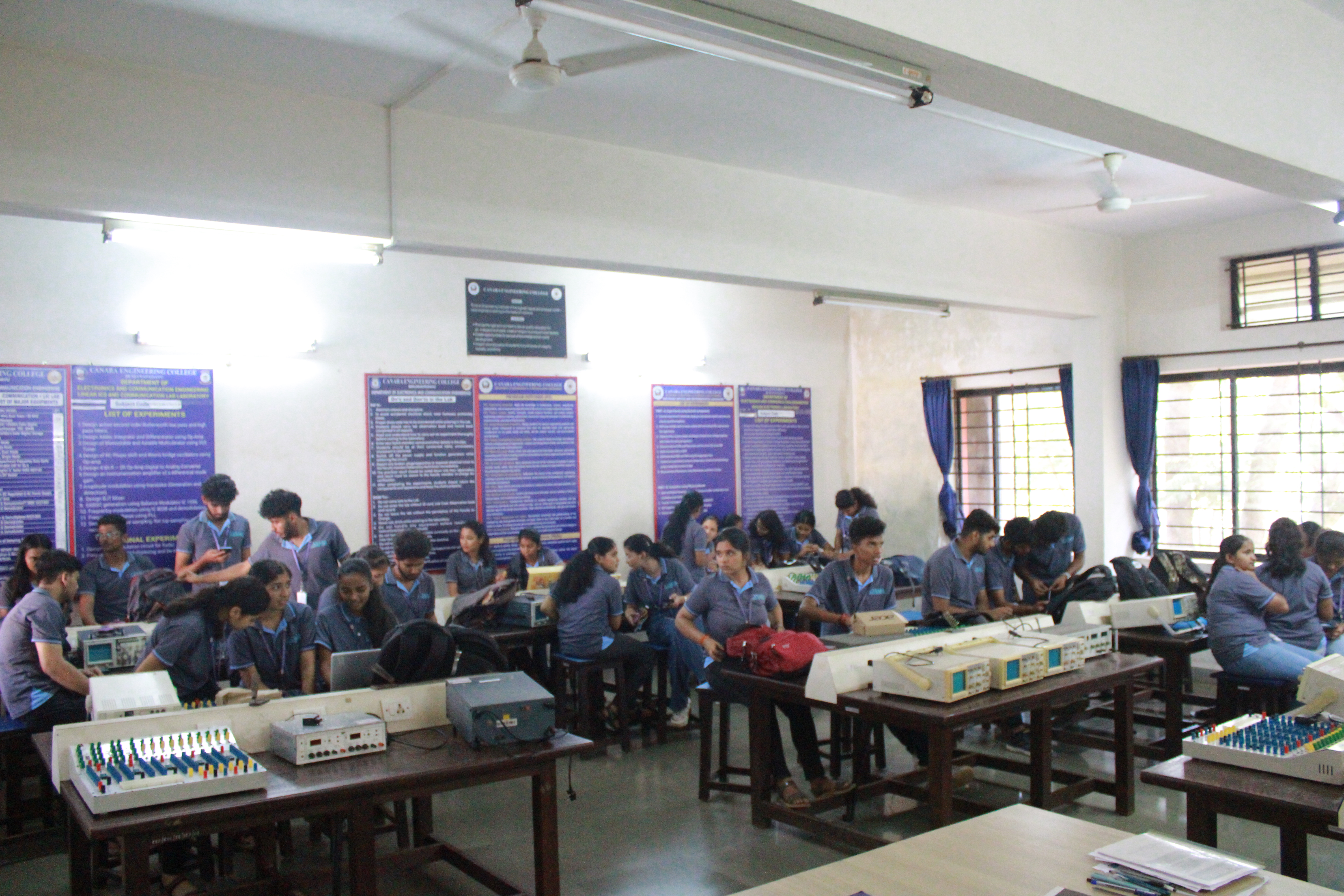 |
This laboratory enables the 2nd year students to get practical experience in design, assembly, testing and evaluation of Rectifiers, Amplifiers, and Oscillators in the 3rd semester and also, Design and analysis of op-amp circuits, multivibrators, and analog communication modules in the 4th semester.
Major facilities
|  |
The study of the various applications of Digital ICs is done in this laboratory by the students in the 2nd year. It is also used exclusively used by the Final Year students to carry out their UG Projects in the even semester
Major facilities/Equipments
|  |
This laboratory is utilized by the 4th year students for VLSI Lab and 3rd year students for Computer Networks lab.Electric software enables to design analog VSLI circuits and layouts and simulate them. Xilinx IDE enables to simulate digital VLSI designs.NCTUNS is used to simulate computer networks using switch and hub for TCP and UDP protocols for different bandwidths and error rates. Shortest routing protocols are executed using C compiler
Major tools
|  |
This laboratory is equipped with MATLAB software, Code Composer Studiowhere students learn to execute signal processing programs in the 5th semester. In the Embedded Controller Lab, the students of 6th semester interface STM32F100RB microcontroller with various peripherals.
List of major tools
|  |
This laboratory enables students of 2nd year to get an exposure to 8086 microprocessor assembly level programming and interfacing of peripheral devices. Also, Verilog programming and FPGA implementation of digital circuits is done for 3rd year students in this laboratory.
Major tools
Software laboratories are equipped with Microsoft Windows 7, Windows 10, Windows XP campus license, MS OFFICE 2003, 2007 campus license |  |
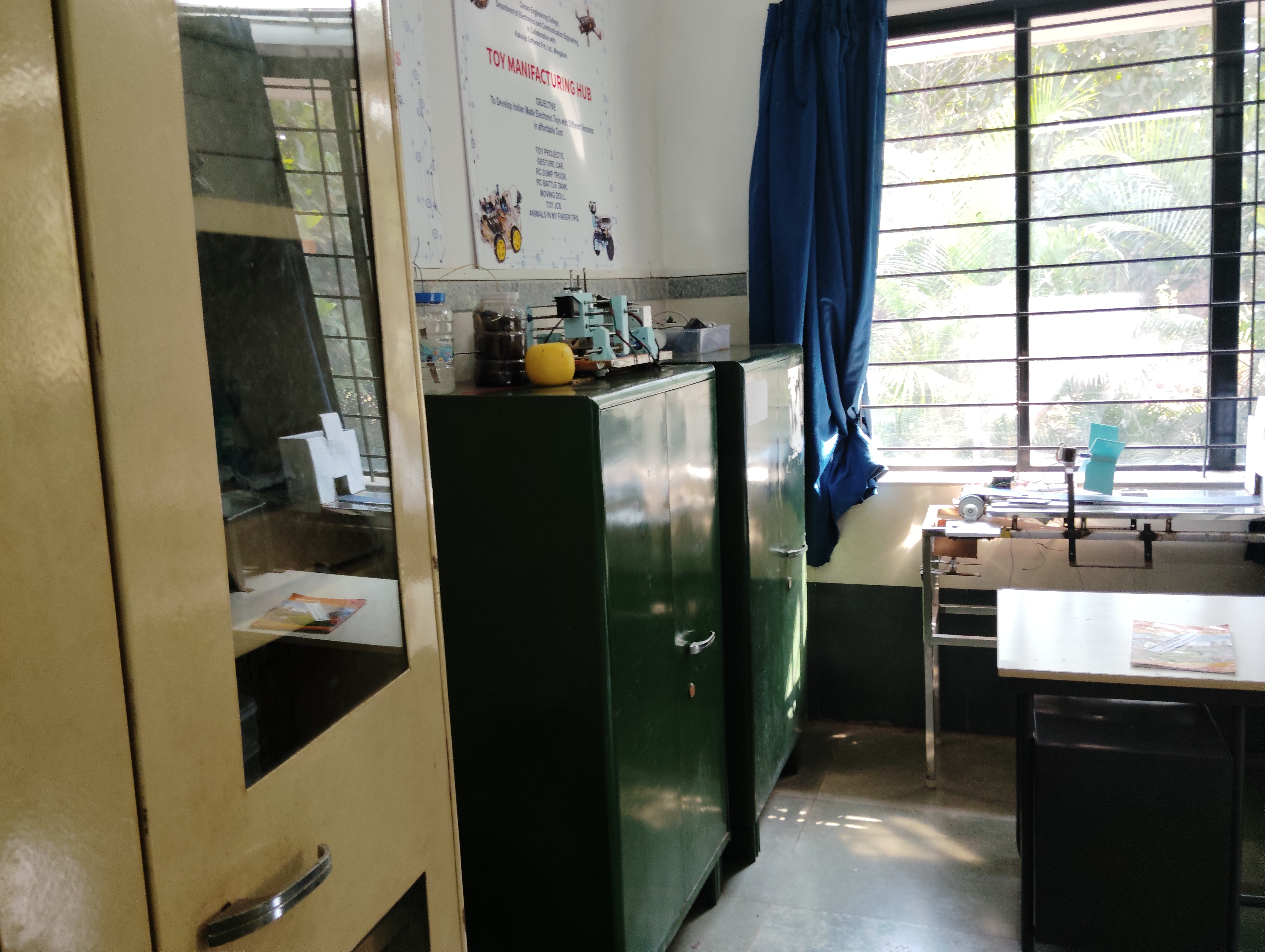
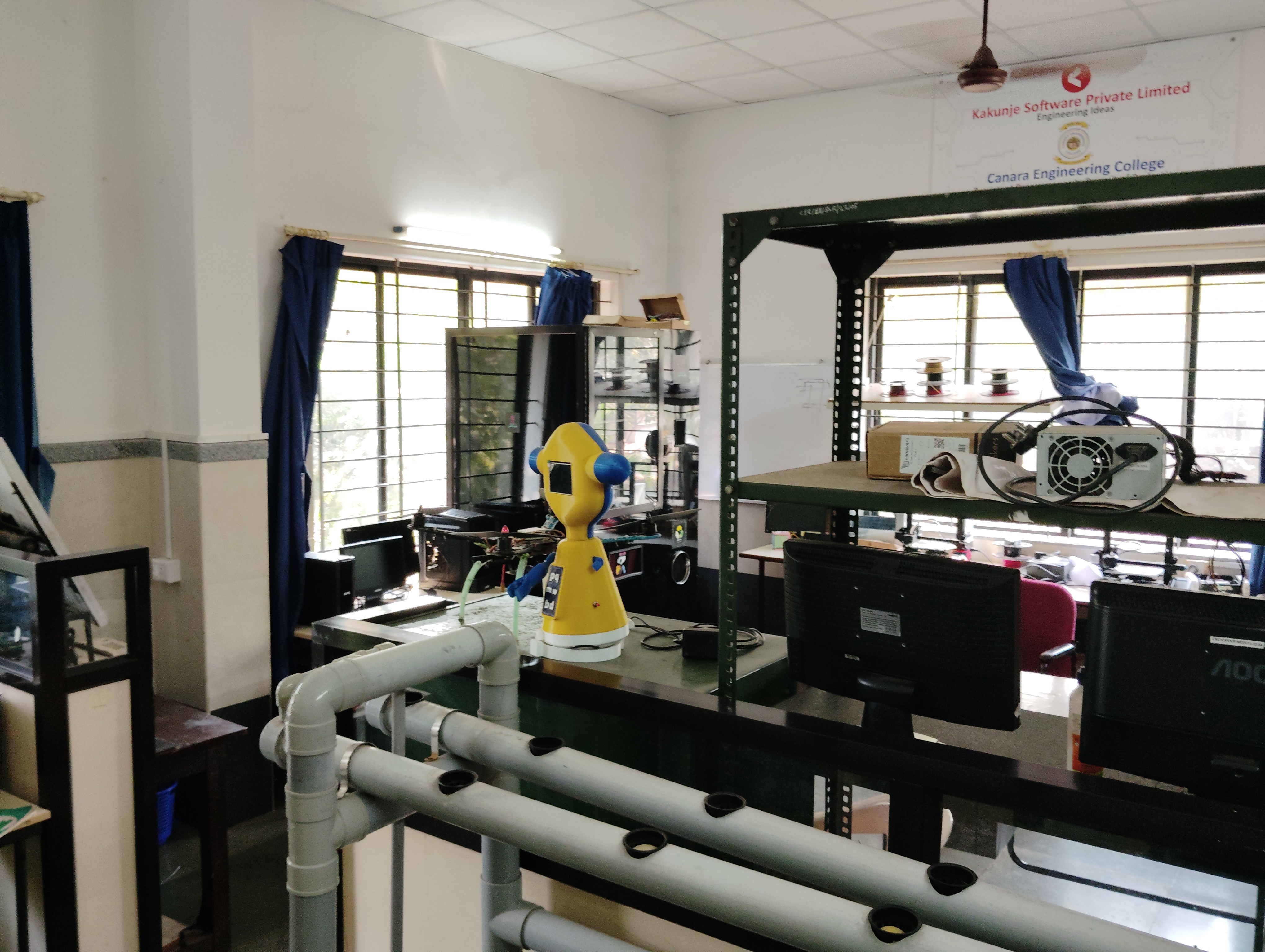
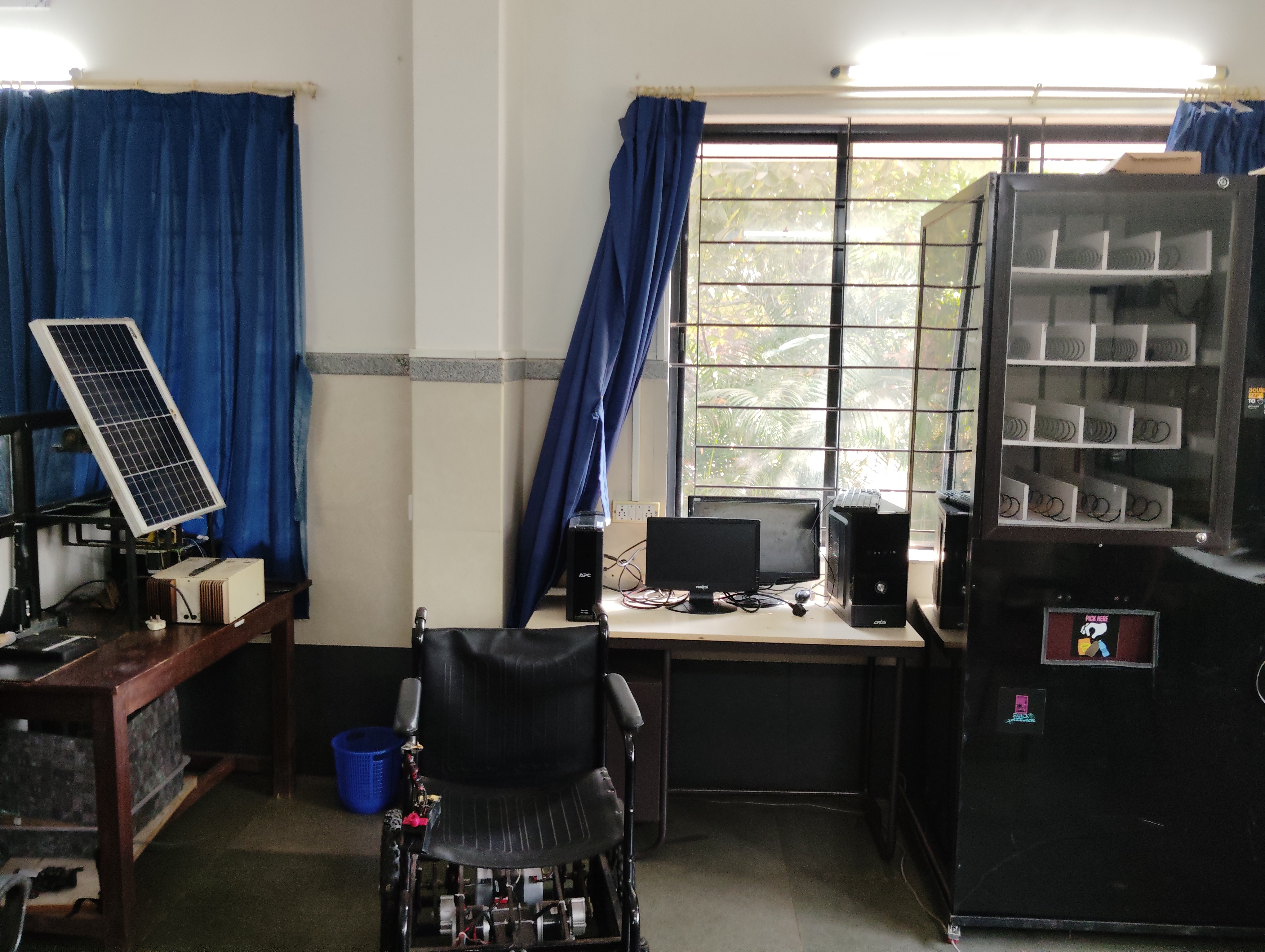
Additional laboratory facilities are created in the department to improve the quality of learning, catering to the needs of the students. This laboratory is used to conduct project and research work and to meet the requirement of beyond working hours
 | |
 | |
 |
|  |
|  |
Department has a tutorial room with a seating capacity of 20 students with LCD projector for conducting tutorial classes.
 |
.png)
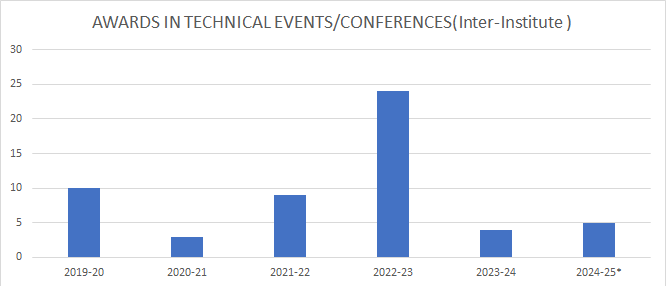

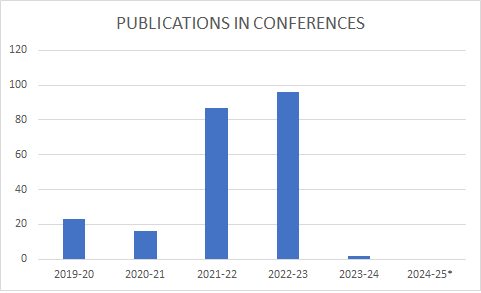
| Domain | Faculty | Research Scholars |
|---|---|---|
| Applied Electronics | Mrs. Jayashree K Mr. Sandeep Prabhu M |
Mrs. Tara B B Mr. Divyesh Divakar Mr.Anantha Krishna Kamath |
| Communication System | Mr. Vinay H S Mrs. Rajitha A A Mr. Sreerama Samartha J G |
Research Scholars |
| VLSI and Embedded System | Dr. Dayananda G K | Mr. Mohan A R |
| Signal Processing and Computer Programming | Dr. Ganesh V. Bhat | Mr. Padmahasa M Mr. Vayusutha M |
| Artificial Intelligence & Machine Learning | Mr. Manjunatha I R Mr. Sujit Satish Pai Mrs. Savitha Acharya Mrs. Akshatha G Baliga Dr.Raghavendra M Shetty K |
Mrs.Suchitra N Shenoy Mr. Ajeya B |
| WORKING MODELS | |||||||||||
|---|---|---|---|---|---|---|---|---|---|---|---|
| YEAR | PROJECT TITLE | GUIDE | MEMBERS | ||||||||
| 2022-23 | MULTI CONTROLLED ELECTRIC WHEEL CHAIR | Ms. Savitha Acharya |
|
||||||||
| 2023-24 | AUTOMATIC RUBBER MILK MIXING MACHINE BY DETERMINING THE DRY RUBBER CONTENT OF LATEX | Mr. Vinay H S |
|
||||||||
| 2023-24 | ADVAYA VAHANA | Ms. Jayashree K |
|
||||||||
| 2023-24 | LOW-COST MYOELECTRIC PROSTHETIC ARM | Dr. Dayananda G K |
|
||||||||
| 2023-24 | VENDING MACHINE USING UPI | Ms. Rajitha A A |
|
||||||||
| 2024-25 | DESIGN AND IMPLEMENTATION OF HELICAL ANTENNA FOR AIRCRAFT COMMUNICATION | Mr. Sreerama Samartha J G |
|
||||||||


| Ms. savitha Acharya | Ms.Jayasree K | Ms. Akshatha G Baliga |
| Mr. Sreerama Samarta J G | Mr. Sandeep Prabhu M | Ms.Rajitha A A |
| Mr. Vinay H S | Mr. Manjunath I R | Mr. Sujith S Pai |
 |
 |
|
 |
 |
 |
 |
 |
 |
| |
| SDP on Technical Skills (08-10-2026) |
|---|
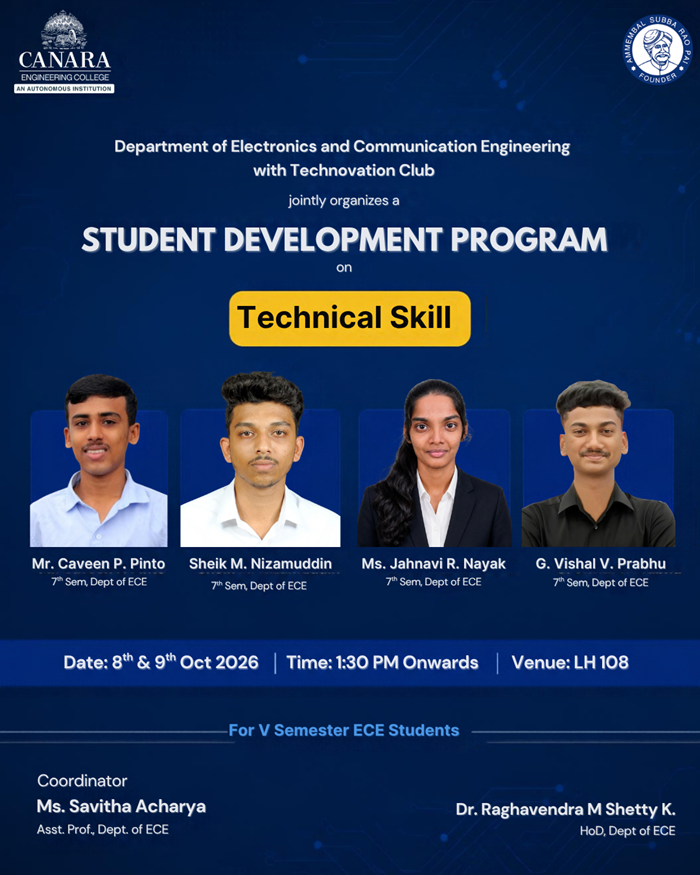
The Department of Electronics and Communication Engineering, jointly with the Technovation Club, organized a Student Development Program on Technical Skills on 8th and 9th October 2026 for V Semester ECE students. The program was conducted by four student resource persons, Mr. Caveen P. Pinto, Mr. Sheik M. Nizamuddin, Ms. Jahnavi R. Nayak, and Mr. G. Vishal V. Prabhu, of the VII Semester ECE. The sessions covered digital fundamentals, including number systems, logic gates, and the design and analysis of combinational and sequential circuits. The students also received valuable guidance on campus interview preparation, helping them strengthen their technical knowledge and placement readiness. Around 30 students benefited from this initiative, which encouraged peer learning and enhanced technical confidence. The program was coordinated by Ms. Savitha Acharya, Assistant Professor, Department of ECE. |
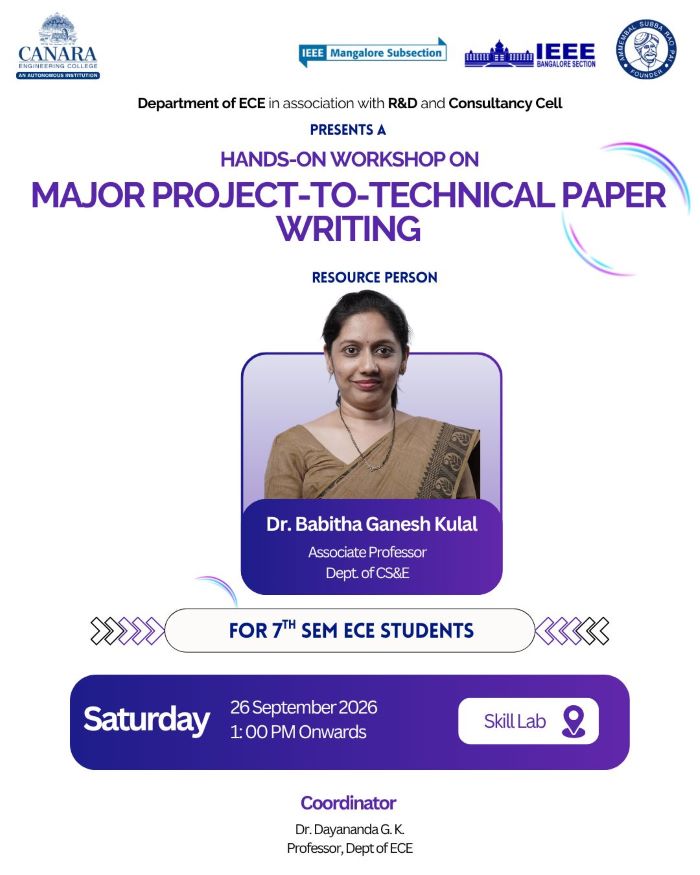
| Hands-On Workshop On Major Project -To -Technical Paper Writing (26-09-2026) |
The R&D and Consultancy Cell in association with the Department of Computer Science and Engineering, Canara Engineering College (CEC) organized a “Hands-On Workshop on Project-to-Technical Paper Writing” on 26.09.2026 at the Skill Lab from 1:00 PM onwards. The workshop was conducted for students to provide practical guidance on transforming their academic projects into well-structured technical research papers. Dr. Babitha Ganesh Kulal, Associate Professor, Department of CSE, Canara Engineering College, served as the Resource Person. The session covered the essential components of a technical paper, including problem identification, literature review, research gap, methodology, results, discussion, conclusion, and references. Students were guided on effective technical writing, systematic literature review, proper citation, plagiarism avoidance, and academic integrity. The workshop also provided insights into selecting suitable conferences and journals and understanding publication guidelines. The session helped students develop the skills required to document their project work as technically sound research contributions suitable for scholarly publication. |
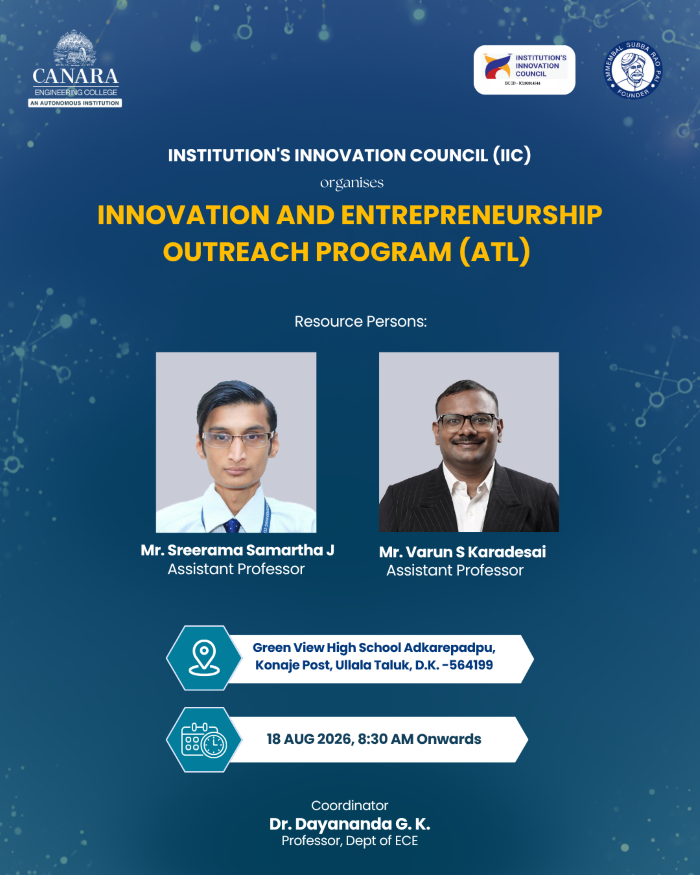
| Innovation and Entrepreneurship Outreach Program (ATL) Green View High School (18-08-2026) |
The Institution's Innovation Council (IIC) of Canara Engineering College organized an Innovation and Entrepreneurship Outreach Program at Green View High School on August 18, 2026. Resource persons Mr. Sreerama Samartha J.G. and Mr. Varun S. Karadesai led the sessions to foster creativity and entrepreneurial thinking among students. A total of 42 school students participated in hands-on technical sessions covering Arduino UNO fundamentals and basic sensor interfacing. Fourteen fifth-semester ECE college students assisted in conducting the workshops and mentoring the participants. Students successfully collaborated to design five practical projects, including a gesture piano, smart street lights, and an automatic toll gate system. Coordinated by Dr. Dayananda G.K., the initiative successfully inspired young minds and was warmly received by the school management. |
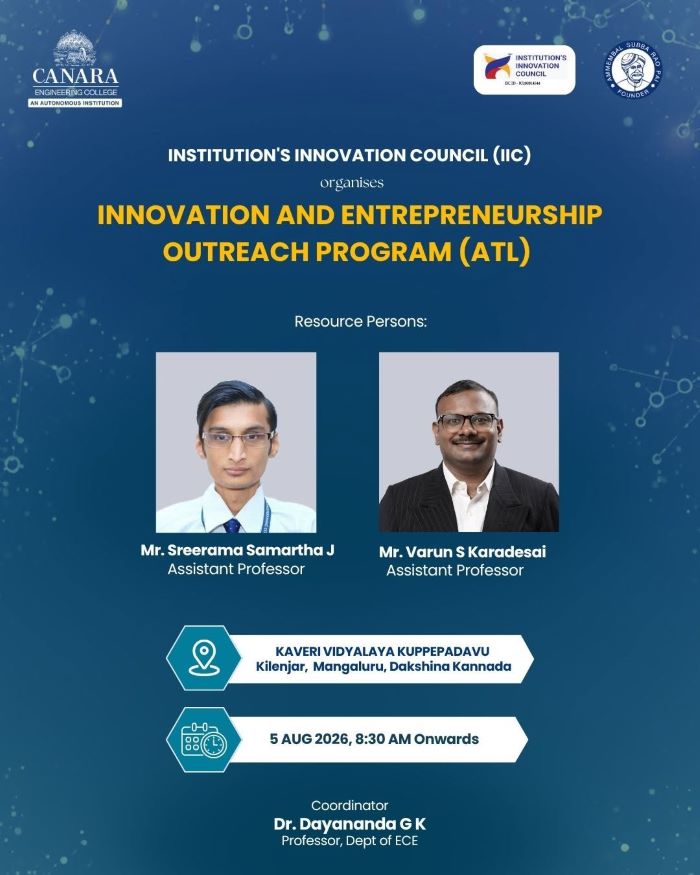
| Innovation and Entrepreneurship Outreach Program (ATL) (05-08-2026) |
The Institution's Innovation Council (IIC), Canara Engineering College, organized the Innovation and Entrepreneurship Outreach Program (ATL) at Kaveri Vidyalaya, Kuppepadavu, Kilenjar, Mangaluru, on 5th August 2026 from 8:30 AM to 6:00 PM. The programme was conducted by Mr. Sreerama Samartha J. and Mr. Varun S. Karadesai with the objective of fostering innovation, creativity, and entrepreneurial thinking among school students. During the hands-on session, students learned the fundamentals of Arduino UNO, basic sensor interfacing, prototype design, and testing techniques. They also participated in interactive activities that encouraged creative thinking, problem-solving, and out-of-the-box innovation. The resource persons explained the importance of converting innovative ideas into practical solutions and motivated students to develop an entrepreneurial mindset. A total of 35 students from Kaveri Vidyalaya actively participated in the workshop, while 14 fifth-semester ECE students from Canara Engineering College assisted in conducting the sessions and mentoring the participants. The programme was successfully coordinated by Dr. Dayananda G.K., Professor, Department of ECE, Canara Engineering College, and was well received by the school management and participants. |
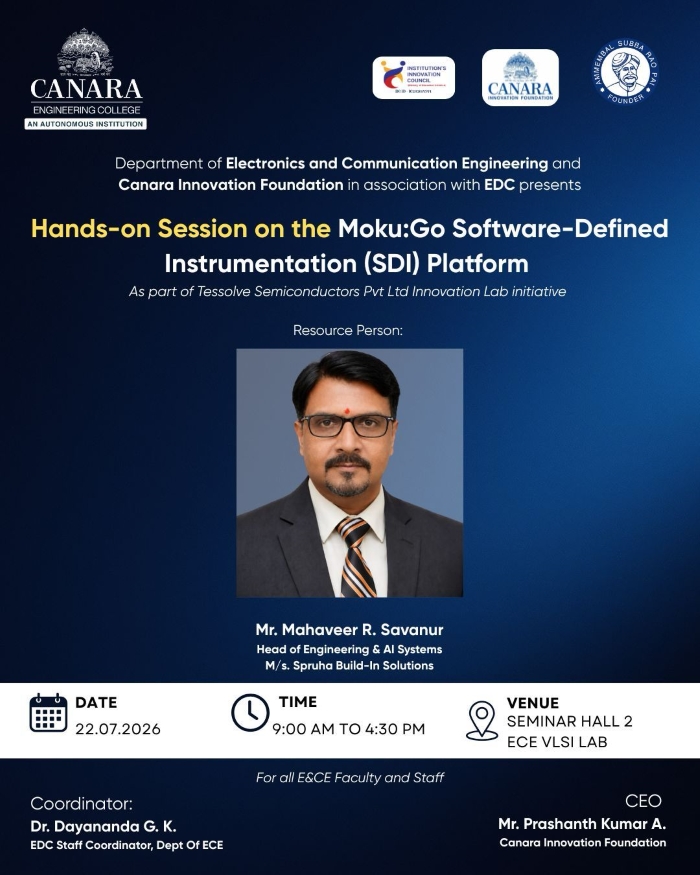
| Hands-on Session on the Moku:Go Software-Defined Instrumentation (SDI) Platform (22-07-2026) |
Report on Hands-on Session on the Moku:Go Software-Defined Instrumentation (SDI) Platform The Department of Electronics and Communication Engineering, in association with the Canara Innovation Foundation (CIF), successfully organized a Hands-on Session on the Moku:Go Software-Defined Instrumentation (SDI) Platform on 22nd July 2026 from 10:00 AM to 4:30 PM at the ECE VLSI Laboratory, Canara Engineering College. The programme was conducted to familiarize faculty members with modern software-defined instrumentation and its applications in engineering education, laboratory experimentation, and research. The inaugural session commenced with a prayer seeking the blessings of the Almighty, followed by a formal welcome to the dignitaries. The programme was graced by Dr. Demian Antony D'Mello, Principal, Dr. Uday Kumar K. Shenoy, Dean – Research & Development and Executive Director, Canara Innovation Foundation and Centre of Excellence, Dr. Raghavendra Shetty, Head of the Department of Electronics and Communication Engineering, Mr. Prashanth Kumar A, CEO, Canara Innovation Foundation, and Dr. Dayananda G.K., EDC Staff Coordinator. Their presence reflected the institution's commitment to promoting innovation, industry collaboration, and technology-enabled learning. The technical session focused on the Moku:Go Software-Defined Instrumentation Platform, a versatile multi-instrument solution that integrates several laboratory instruments into a single compact device. Through live demonstrations and practical experiments, participants explored the functionality of various virtual instruments available in the Moku:Go platform, including the oscilloscope, waveform generator, logic analyzer, spectrum analyzer, and power supply. The resource person explained how software-defined instrumentation simplifies laboratory setup, reduces equipment costs, and enhances flexibility in conducting experiments. During the hands-on session, participants gained practical experience in interfacing different electronic circuits with the Moku:Go platform, configuring various measurement tools, and testing electronic circuits using different software-defined functions. The demonstrations highlighted signal generation, waveform analysis, frequency-domain measurements, digital signal acquisition, and troubleshooting techniques. The session also illustrated how a single programmable platform can replace multiple conventional laboratory instruments, making engineering laboratories more efficient and industry-oriented. Approximately 25 faculty members and technical staff actively participated in the workshop. The interactive nature of the programme encouraged participants to perform experiments independently, clarify technical concepts, and discuss potential applications of the platform in undergraduate laboratories, project work, and research activities. The workshop also provided an opportunity to understand how modern software-defined instrumentation can support outcome-based education, interdisciplinary learning, and practical skill development. Overall, the programme was highly informative and beneficial. . The Department expressed its sincere gratitude to the management, Canara Innovation Foundation, the resource person, and all participants for making the programme a grand success. Link https://www.linkedin.com/feed/update/urn:li:activity:7485346982912294912 |
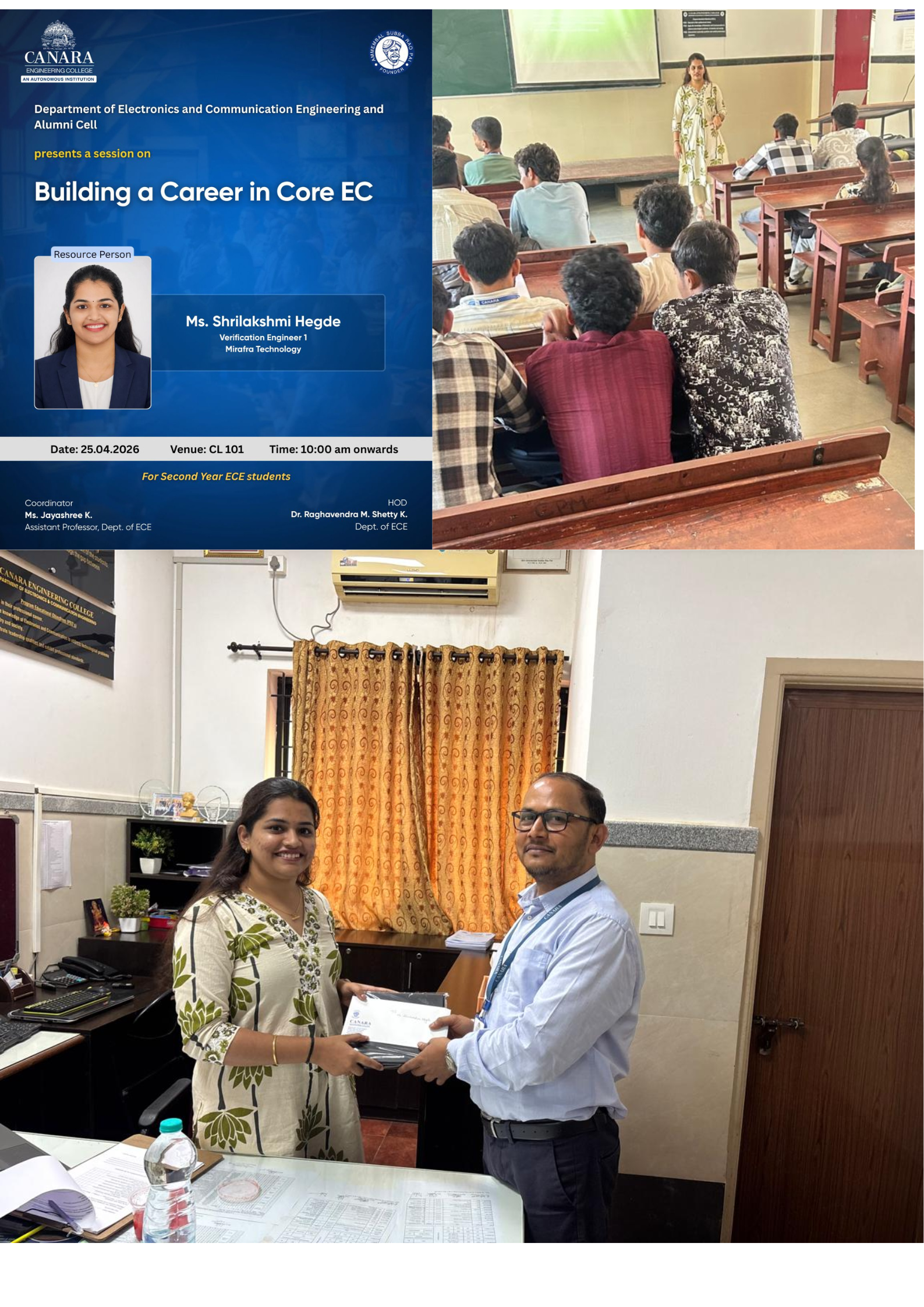
| Building a Career in Core EC (25-04-2026) |
The Department of Electronics and Communication Engineering, in association with the Alumni Cell, organized an expert talk on “Building a Career in Core EC” for 4th semester EC students. The session was delivered by Ms. Shrilakshmi Hegde, Verification Engineer at Mirafra Technology. She shared valuable insights on career opportunities in the core electronics domain, industry expectations, and the skills required to succeed in the VLSI and verification field. The speaker also guided students on higher studies, internships, and placement preparation. The session was highly interactive and motivated students to explore career paths in core EC industries. |
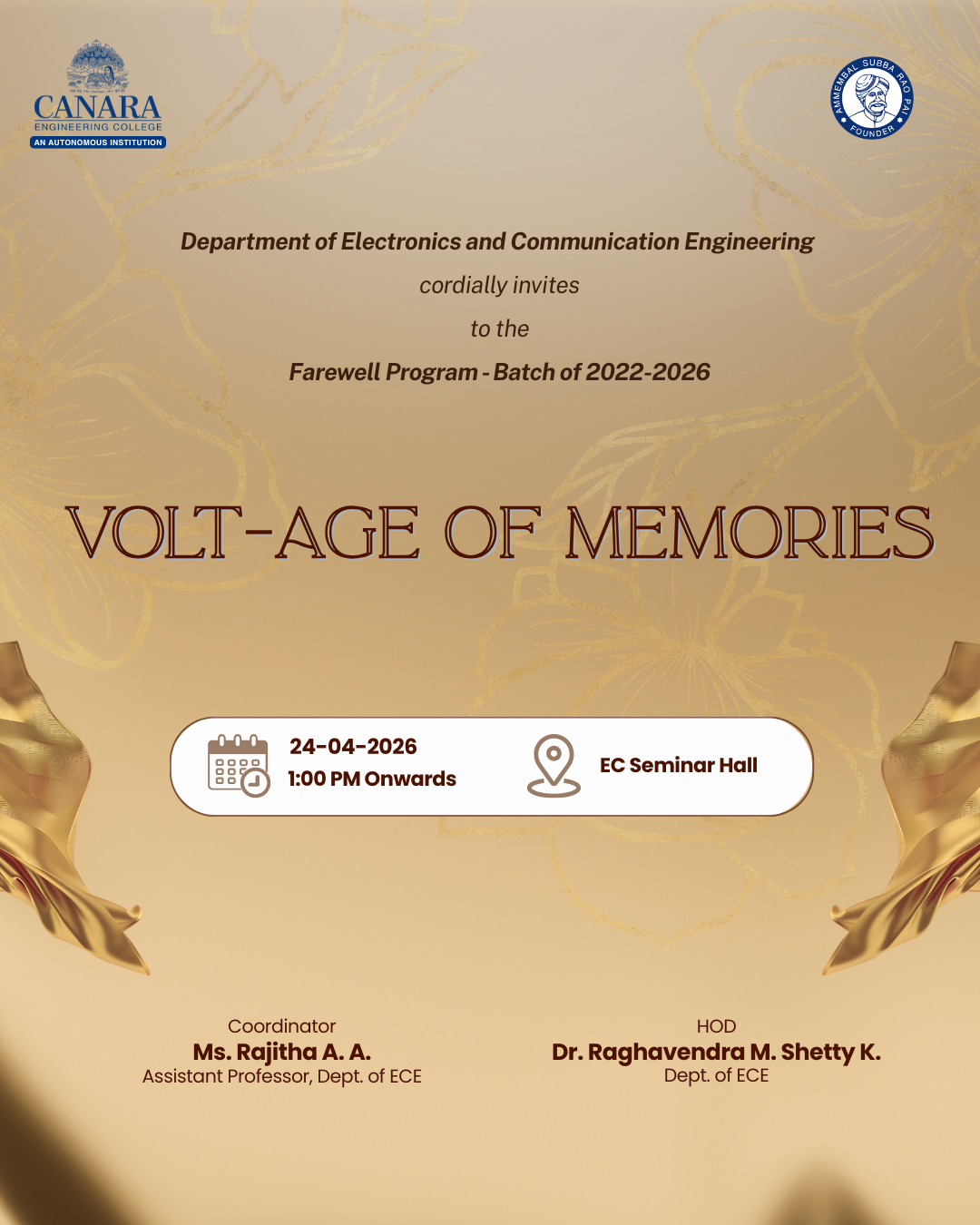
| Farewell Program (24-04-2026) |
The Department of Electronics and Communication Engineering organized a memorable farewell program titled “VOLT-AGE OF MEMORIES” to the 2022 graduating batch. The event was graced by the Head of the Department, Dr. Raghavendra M. Shetty K, who addressed the students and conveyed his heartfelt wishes for their bright future. The farewell celebration was filled with joy and enthusiasm, featuring a series of engaging games that created a lively and cheerful atmosphere. The juniors added to the spirit of the occasion with energetic dance performances, making the event even more vibrant and enjoyable. The program concluded on an emotional yet happy note, leaving behind beautiful memories for both juniors and seniors. The event was coordinated by Ms. Rajitha A A, Assistant Professor, Electronics and Communication Engineering. |
| Career Readiness Bootcamp (25-03-2026) |
The Department of Electronics and Communication Engineering organized a Student Development Program titled “Career Readiness Bootcamp”, which was conducted from 25/03/2026 to 09/04/2026 and comprised a total of 24 hours. The program covered a wide range of core subjects, including Analog Electronics, Network Analysis, Digital Electronics, and Verilog HDL. The program commenced on 25/03/2026, with a session on PN junction diode and its V-I characteristics delivered by Dr. Raghavendra M. Shetty K, where students gained insights into semiconductor fundamentals and diode behavior. On 26/03/2026, Mr. Sreerama Samartha conducted a session on clippers and clampers, along with the realization of basic logic gates using diodes, helping students understand waveform shaping and logic implementation. The session on 27/03/2026, handled by Ms. Jayashree K, covered Kirchhoff’s laws (KCL & KVL), Thevenin’s and Norton’s theorems, and the Maximum Power Transfer theorem, enabling students to analyze and simplify electrical networks effectively. On 28/03/2026 (morning session), Dr. Raghavendra M. Shetty K explained transient response in RC and RL circuits, focusing on time-domain analysis. This was followed by another session on the same day by Dr. Ganesh V. Bhat, who discussed Operational Amplifiers and their applications, including integrators, differentiators, summers, and difference amplifiers. The session on 01/04/2026 by Mr. Sreerama Samartha covered BJT and MOSFET construction, working principles, characteristics, and biasing techniques, providing a strong foundation in analog electronics. On 02/04/2026, Ms. Savitha Acharya introduced Digital Electronics – Combinational Circuits, focusing on logic design and implementation. The session on 08/04/2026 by Dr. Dayananda G. K dealt with Sequential Circuits, helping students understand memory elements and state-based design. The program concluded on 09/04/2026 with an extended session on Verilog HDL conducted by Mr. Varun Karadesai, where students were introduced to hardware description language and its applications in digital design. This SDP was coordinated by Ms. Rajitha A A, Assistant Professor, Dept. of ECE |
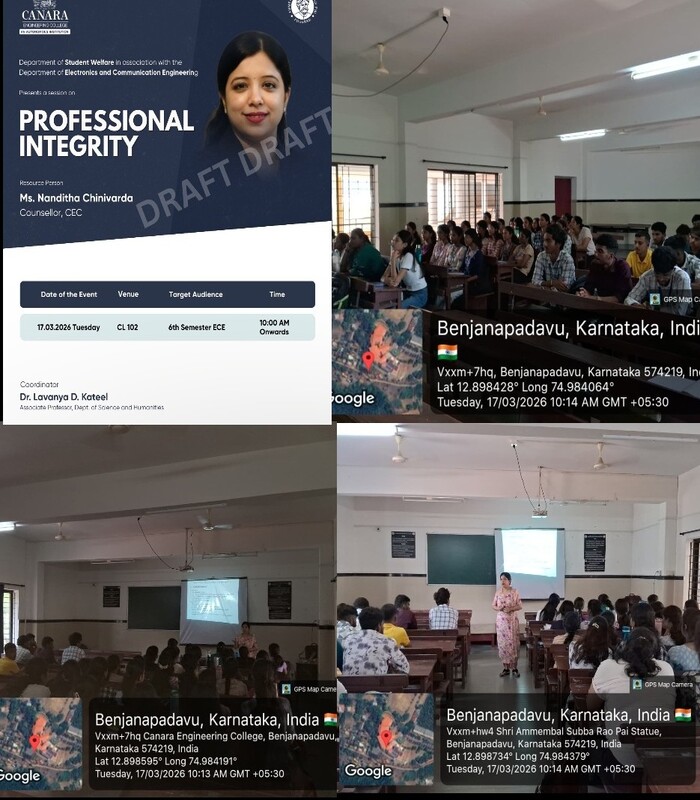
| Professional Integrity (17-03-2026) |
A session on “Professional Integrity” was organised by the Department of Student Welfare on 17th March 2026, in association with the Department of Electronics and Communication Engineering CEC, Benjanpadav, exclusively for the 3rd-year ECE students at CL102. The session was coordinated by Dr Lavanya. D. Kateel. The session was conducted to help students realise the importance of ethical conduct, sincerity, accountability, and consistency in their actions, emphasising their relevance in both academic pursuits and professional practice. The session included real-life case studies highlighting ethical dilemmas, professional conduct, workplace ethics, honesty, accountability, and social responsibility. Students actively participated in discussions and shared their viewpoints on various ethical situations. The interactive approach helped students understand the importance of integrity in building trust, credibility, and long-term professional success. The session effectively sensitized students to ethical responsibilities and encouraged them to practice ethical values in academic and professional life |
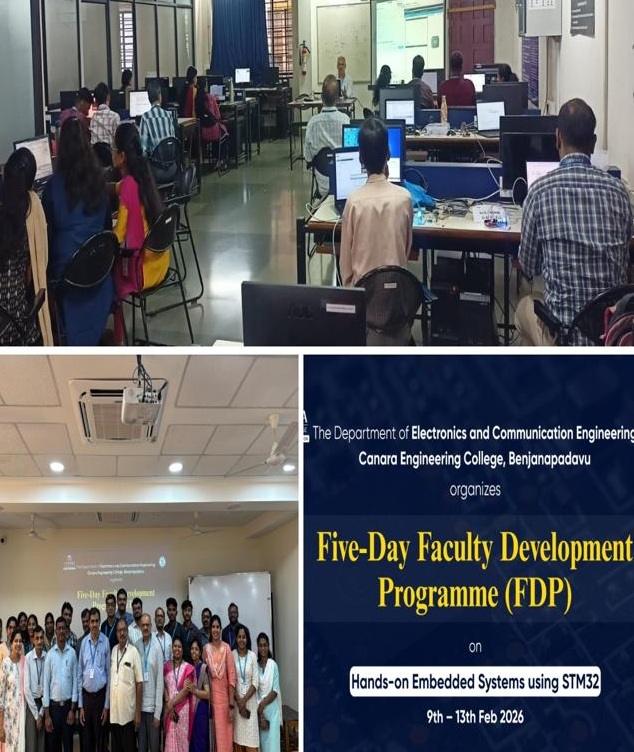
| Five Day FDP on "Hands-on Embedded Systems using STM32" (09-02-2026) |
The Department of Electronics and Communication Engineering organized a Five-Day Faculty Development Programme (FDP) on “Hands-on Embedded Systems using STM32” at Canara Engineering College from 9th to 13th February 2026. The programme witnessed active participation from 34 faculty members of Canara Engineering College as well as faculty from other institutions, representing Electronics, Electrical, Computer Science, and related disciplines. The five-day FDP emphasized a strong practical orientation, with extensive hands-on sessions enabling participants to gain real-time experience in working with STM32 microcontrollers. The sessions covered key topics such as STM32 architecture, ARM Cortex-M fundamentals, GPIO programming, timer configuration, UART communication, sensor interfacing, and debugging techniques using STM32CubeIDE. The FDP also introduced participants to the concept of Artificial Intelligence at the edge through TinyML, highlighting the growing importance of integrating intelligence into embedded systems. The programme was coordinated by Ms. Savitha Acharya, Assistant Professor, Department of Electronics and Communication Engineering, under the guidance of Dr. Raghavendra M Shetty K, Head of the Department of Electronics and Communication Engineering, and with the support of the faculty members of the department. Objectives of the FDP: • To understand the architecture and programming of STM32 microcontrollers and to develop practical skills in configuring and interfacing embedded peripherals such as GPIO, timers, and communication interfaces. • To provide hands-on experience in developing and debugging embedded system applications using STM32CubeIDE. • To introduce participants to emerging trends such as TinyML and AI on embedded platforms. |
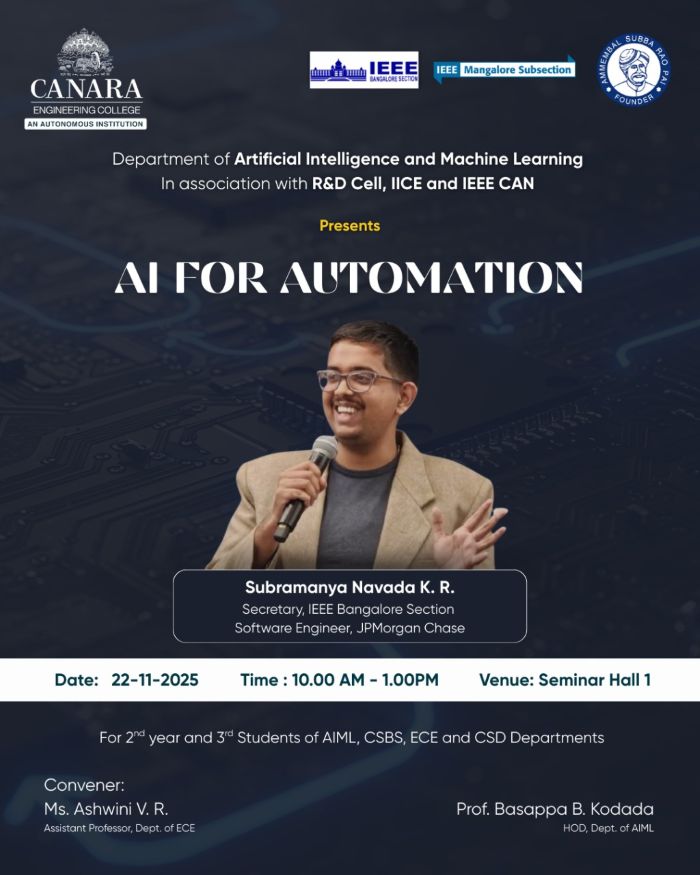
| AI for automation workshop (22-12-2025) |
Organized By IEEECan, IEEE Student Branch, CEC, in association with Dept. of AIML, R&D Cell, and IIC CEC, The target audience was mainly second and third year students of AIML, CSD, and ECE, Open to students from all departments and semesters. Workshop Highlights were: Use of APIs and Retrieval-Augmented Generation (RAG) models, GPT 5.0 applications, DeepSeek AI R1, Gemini 2.0 for automation of routine tasks with prerequisites: Basic knowledge of Python programming, Students required to bring laptops with active internet connection, with Hands-on practice conducted using Google CoLab. at Seminar hall 1. |
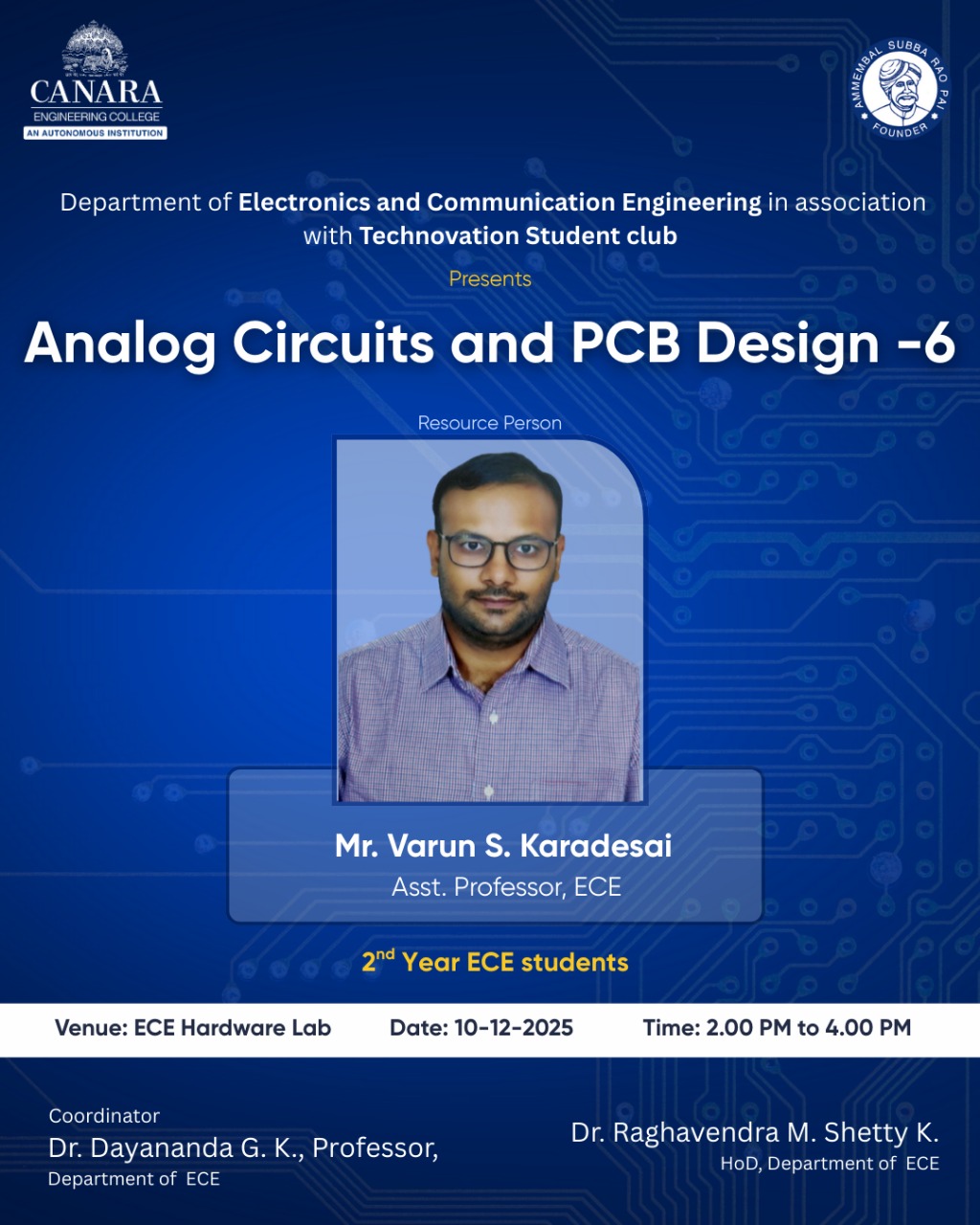
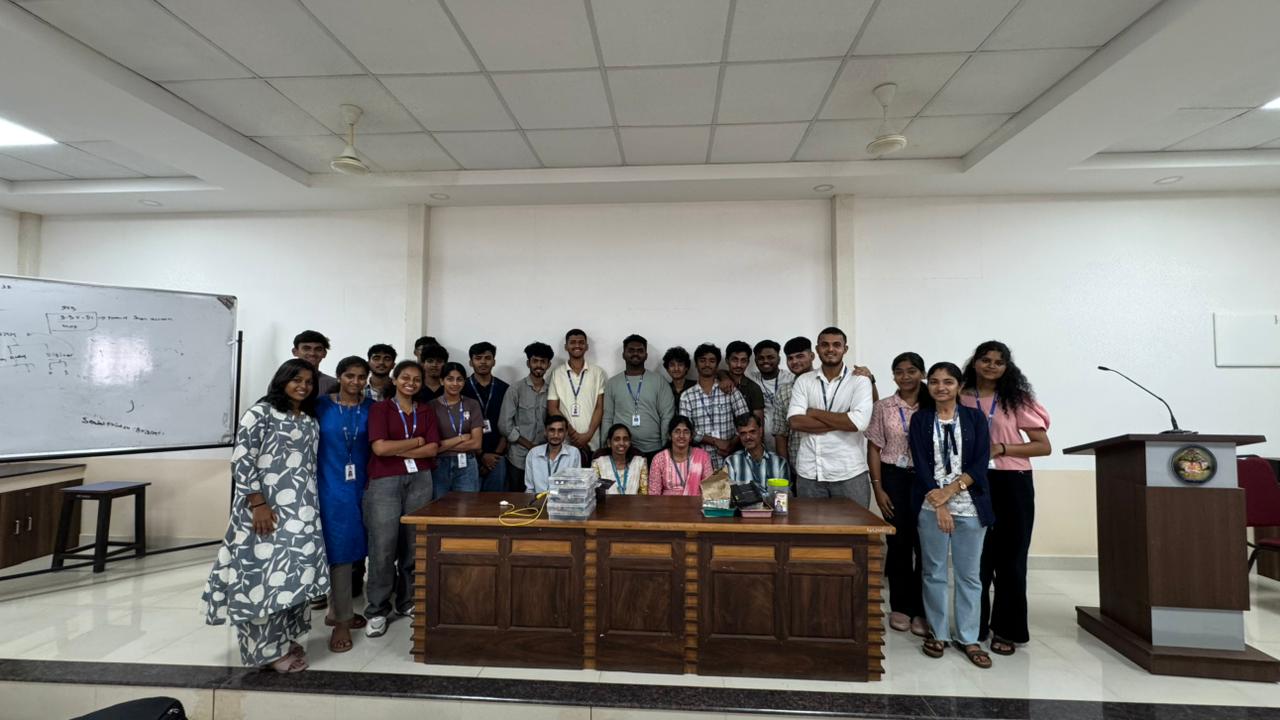
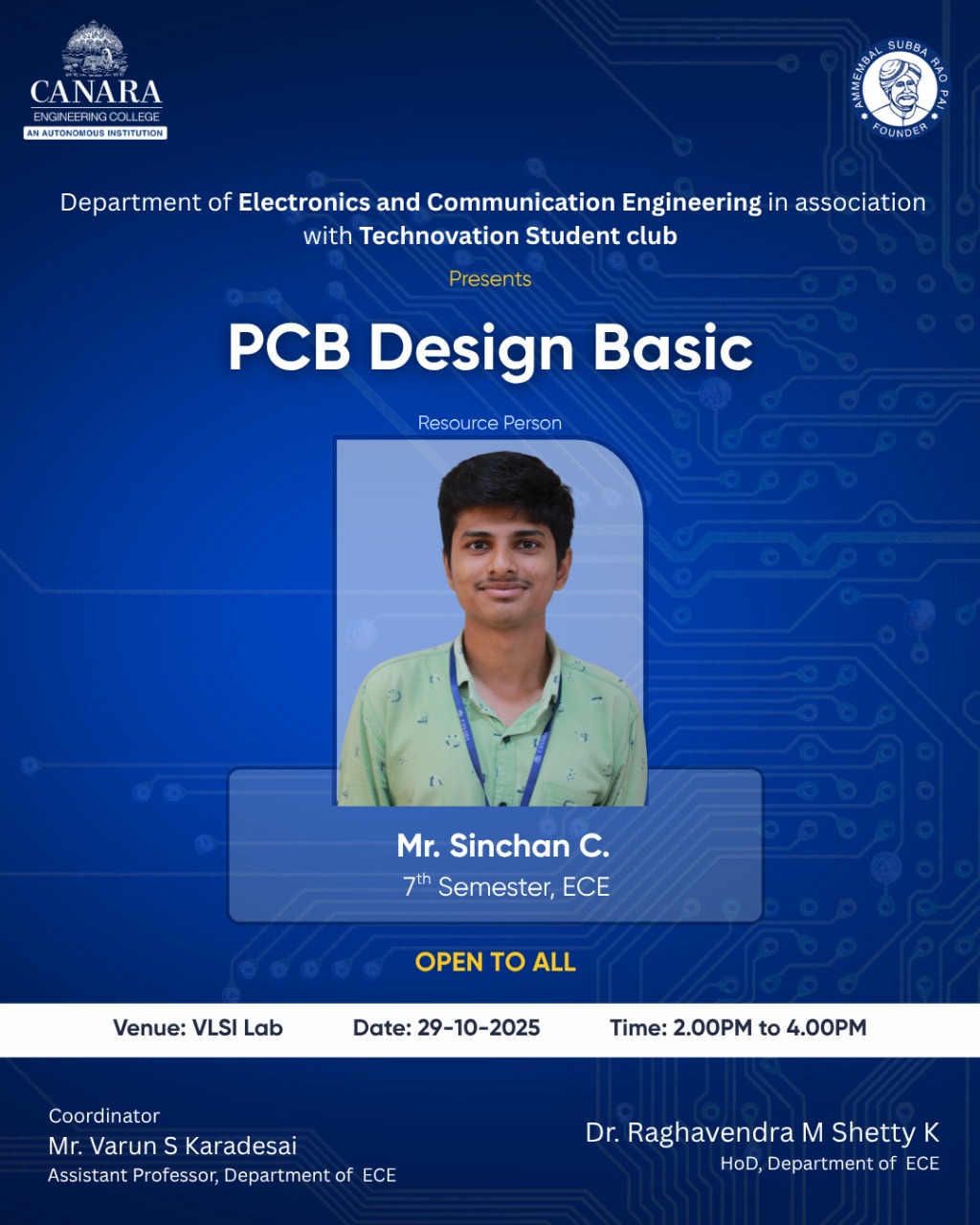
| PCB Design Basics (10-12-2025) |
Understand the basics of PCBs: learn about types, materials, and manufacturing processes used in designing electronic circuits. Apply Design Principles: Learn how to make schematic diagrams and translate them into PCB layouts using design software tools. Implement design rules: Apply electrical, mechanical, and safety design rules to ensure manufacturable and reliable PCB designs. Develop Fabrication-Ready Files: Create Gerber files and related documentation necessary for the fabrication and assembly of the PCB. Analyze and Troubleshoot Designs: Identify and correct layout errors, optimize trace routing, and ensure signal integrity in practical PCB applications |
| LINE FOLLOW ROBOT (06-12-2025) |
The Line Following Robot event at TECHNOVA fest invites PU students to explore the world of robotics by building and programming robots that can autonomously follow a pre-set path. Participants will work with sensors, motors, and control algorithms to create robots that navigate with precision. The event promotes hands-on learning and problem-solving, encouraging students to apply theoretical knowledge in a practical setting. It fosters innovation, teamwork, and creativity while offering a glimpse into the exciting field of robotics and automation. Students will gain valuable skills that can be applied in future engineering and technology projects. |
| Industrial Visit (04-12-2025) |
An industrial visit to the Bio Incubator Centre and Manipal University Technology Business Incubator (MUTBI), Manipal, was organized to expose students to innovation and startup incubation ecosystems. Faculty members from the Department of ECE accompanied the students to the facility. Experts explained the role of bio incubators in supporting biotechnology, healthcare, and technology-based startups. The infrastructure, shared laboratories, prototyping facilities, and regulatory support available to incubatees were discussed. The MUTBI team outlined the startup lifecycle, mentorship programs, funding opportunities, and IP management processes. Students interacted with incubated startups and gained insights into product development and commercialization challenges. The visit concluded with a briefing on government-supported innovation initiatives and opportunities for internships and research collaboration.The event is coordinated by Vinay H S |
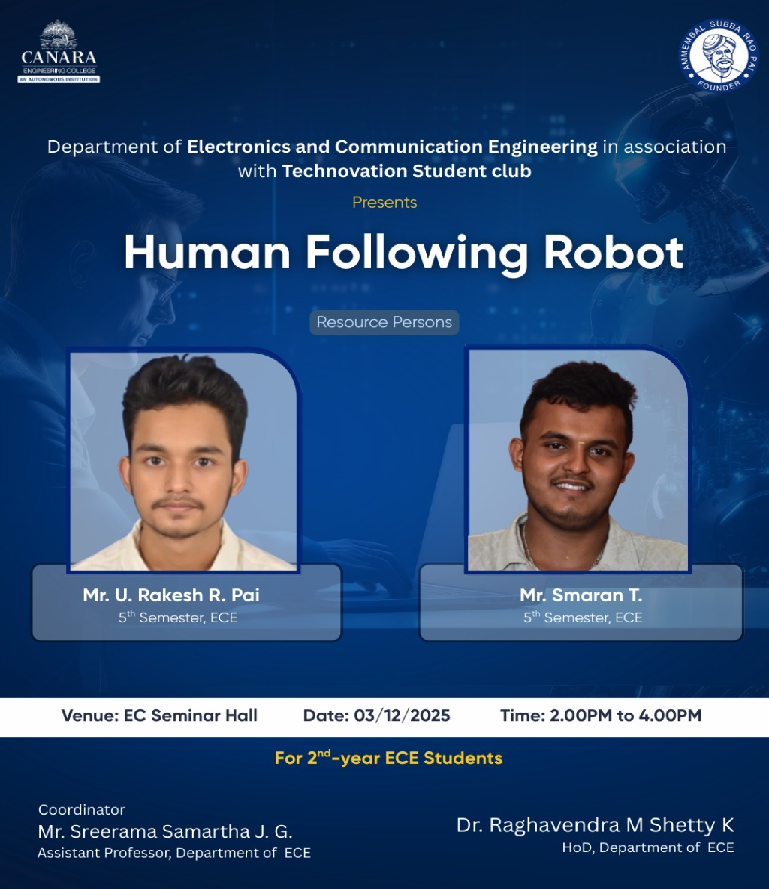
| HUMAN FOLLOWIN ROBOT -2 (03-12-2025) |
The Human Following Robot event focuses on demonstrating an autonomous robotic system capable of detecting and following a human in real time. The event highlights the use of sensors, computer vision, and artificial intelligence in robotics. Participants gain insight into human–robot interaction and autonomous navigation techniques. It encourages innovation and problem-solving in the field of robotics and automation. The event also showcases real-world applications such as assistance, guidance, and surveillance. Overall, it provides a practical learning experience and promotes interest in advanced robotic technologies. |
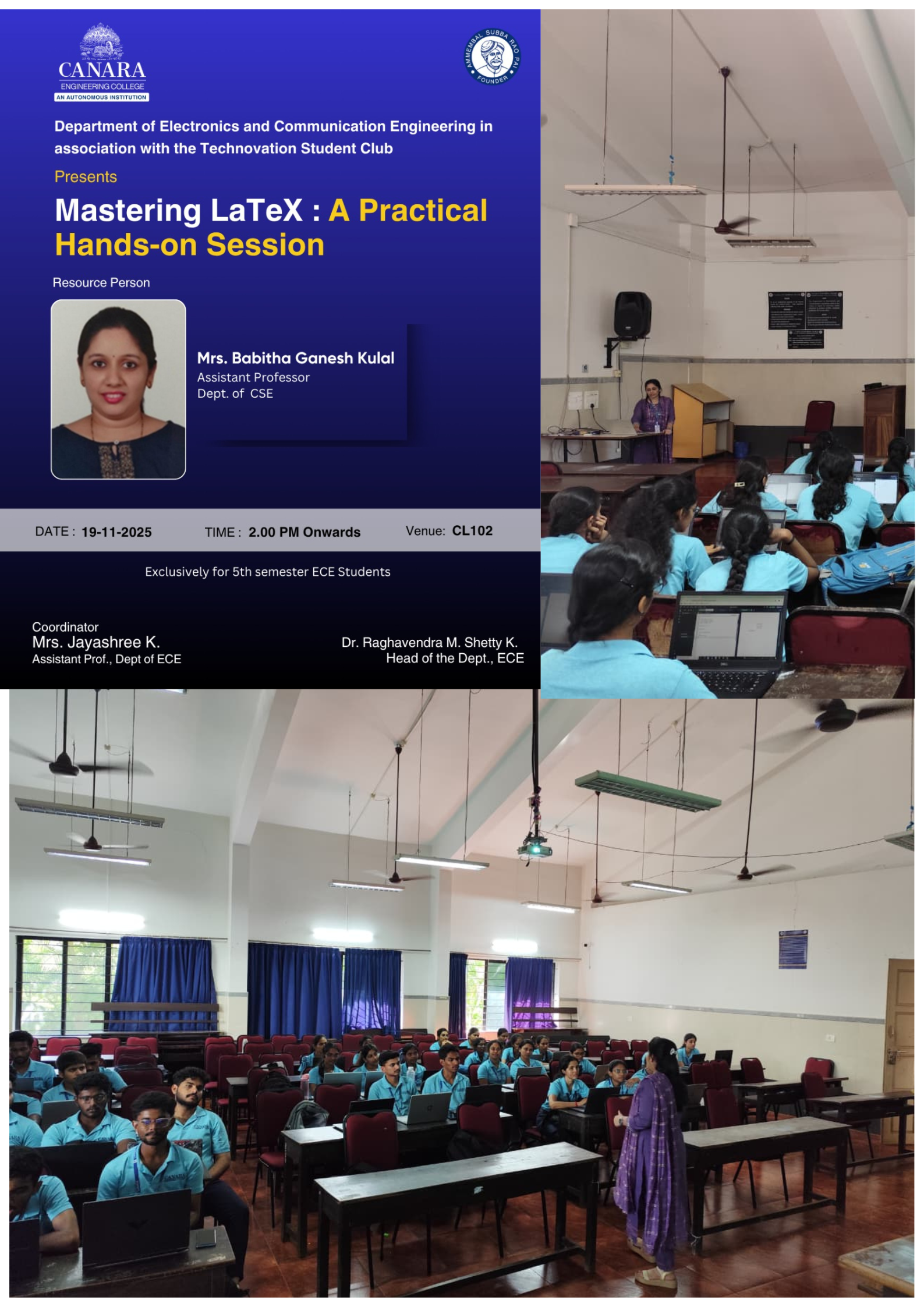
| Mastering LaTeX: A Practical Hands-on Session (19-11-2025) |
The Department of Electronics and Communication Engineering, in association with the Technovation Student Club, organized a hands-on session titled “Mastering LaTeX: A Practical Hands-on Session” on 19th November 2025 for the 5th semester ECE students. The session was conducted by Ms. Babitha Ganesh Kulal, Assistant Professor, Department of Computer Science and Engineering, and was coordinated by Mrs. Jayashree K, Assistant Professor, Department of Electronics and Communication Engineering. The session was held from 2:00 PM to 4:30 PM and focused on introducing LaTeX and its practical applications in technical documentation and academic writing. The resource person demonstrated essential LaTeX commands and guided the students through hands-on exercises, providing practical exposure to document preparation using LaTeX. A total of 35 students actively participated in the session, making it an informative and beneficial learning experience. |
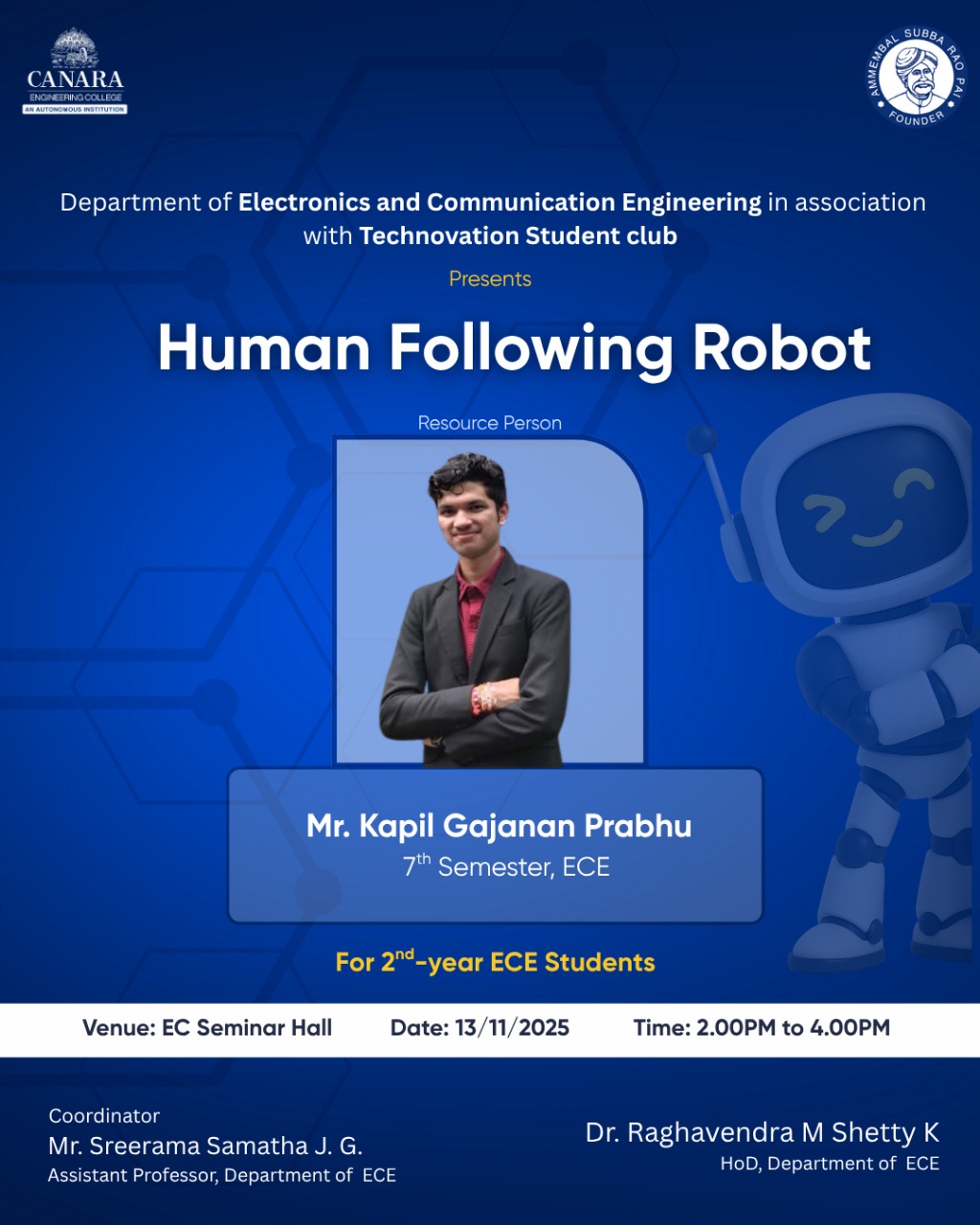
| HUMAN FOLLOWIN ROBOT -1 (13-11-2025) |
The *Human Following Robot* event focuses on demonstrating an autonomous robotic system capable of detecting and following a human in real time. The event highlights the use of sensors, computer vision, and artificial intelligence in robotics. Participants gain insight into human–robot interaction and autonomous navigation techniques. It encourages innovation and problem-solving in the field of robotics and automation. The event also showcases real-world applications such as assistance, guidance, and surveillance. Overall, it provides a practical learning experience and promotes interest in advanced robotic technologies. |
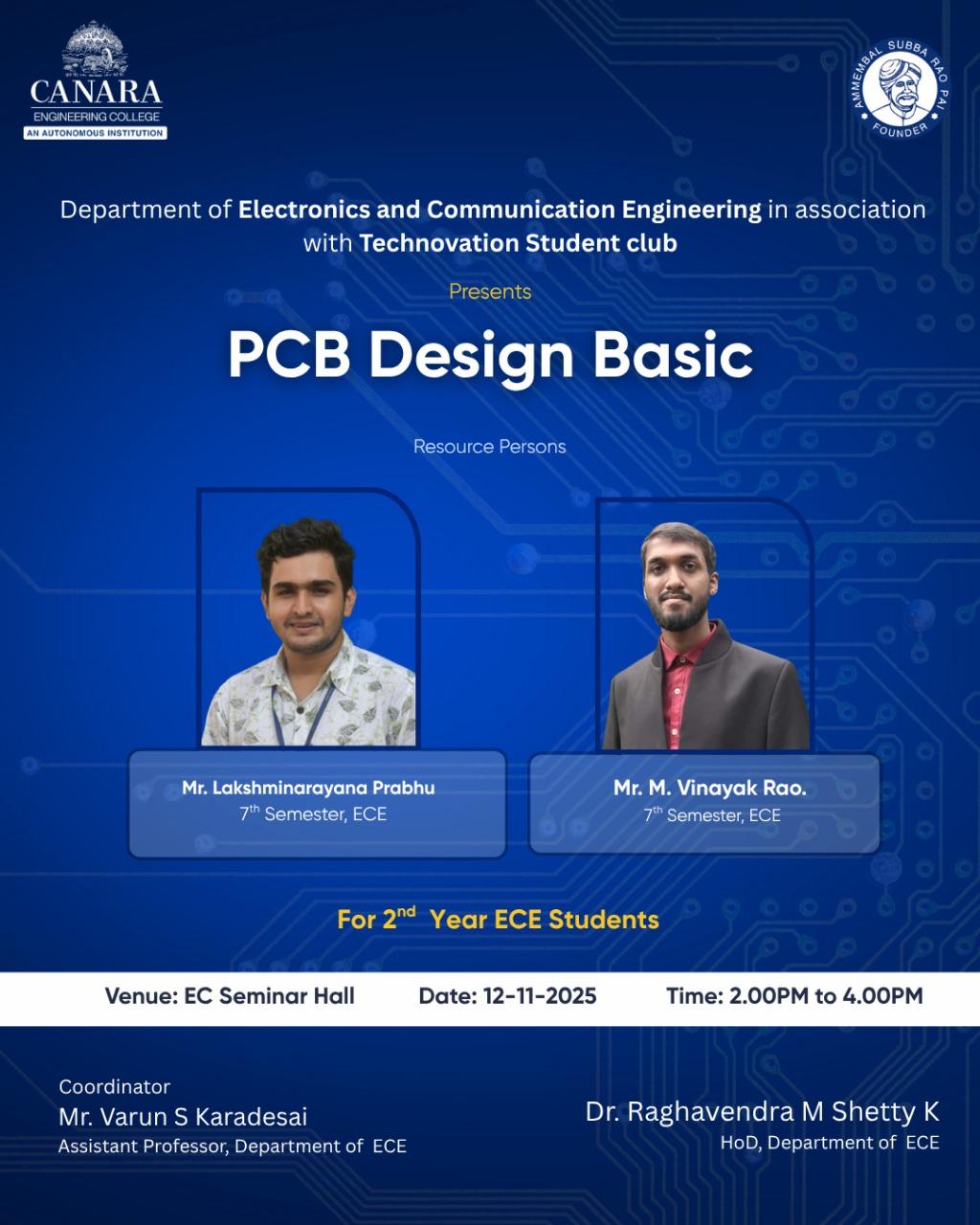
| PCB Design Basics (12-11-2025) |
Understand the basics of PCBs: learn about types, materials, and manufacturing processes used in designing electronic circuits. Apply Design Principles: Learn how to make schematic diagrams and translate them into PCB layouts using design software tools. Implement design rules: Apply electrical, mechanical, and safety design rules to ensure manufacturable and reliable PCB designs. Develop Fabrication-Ready Files: Create Gerber files and related documentation necessary for the fabrication and assembly of the PCB. Analyze and Troubleshoot Designs: Identify and correct layout errors, optimize trace routing, and ensure signal integrity in practical PCB applications |
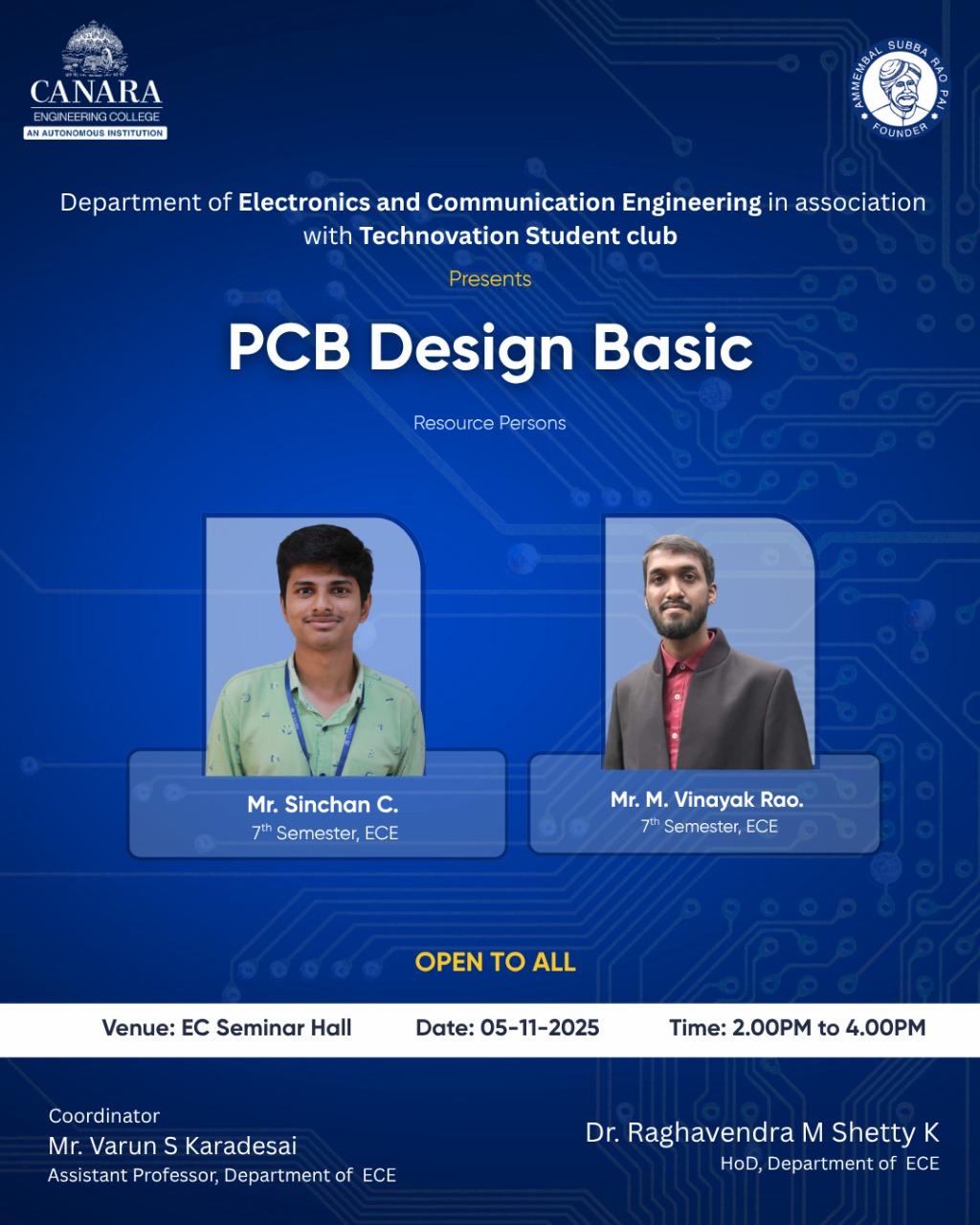
| PCB Design Basics (05-11-2025) |
Understand the basics of PCBs: learn about types, materials, and manufacturing processes used in designing electronic circuits. Apply Design Principles: Learn how to make schematic diagrams and translate them into PCB layouts using design software tools. Implement design rules: Apply electrical, mechanical, and safety design rules to ensure manufacturable and reliable PCB designs. Develop Fabrication-Ready Files: Create Gerber files and related documentation necessary for the fabrication and assembly of the PCB. Analyze and Troubleshoot Designs: Identify and correct layout errors, optimize trace routing, and ensure signal integrity in practical PCB applications |
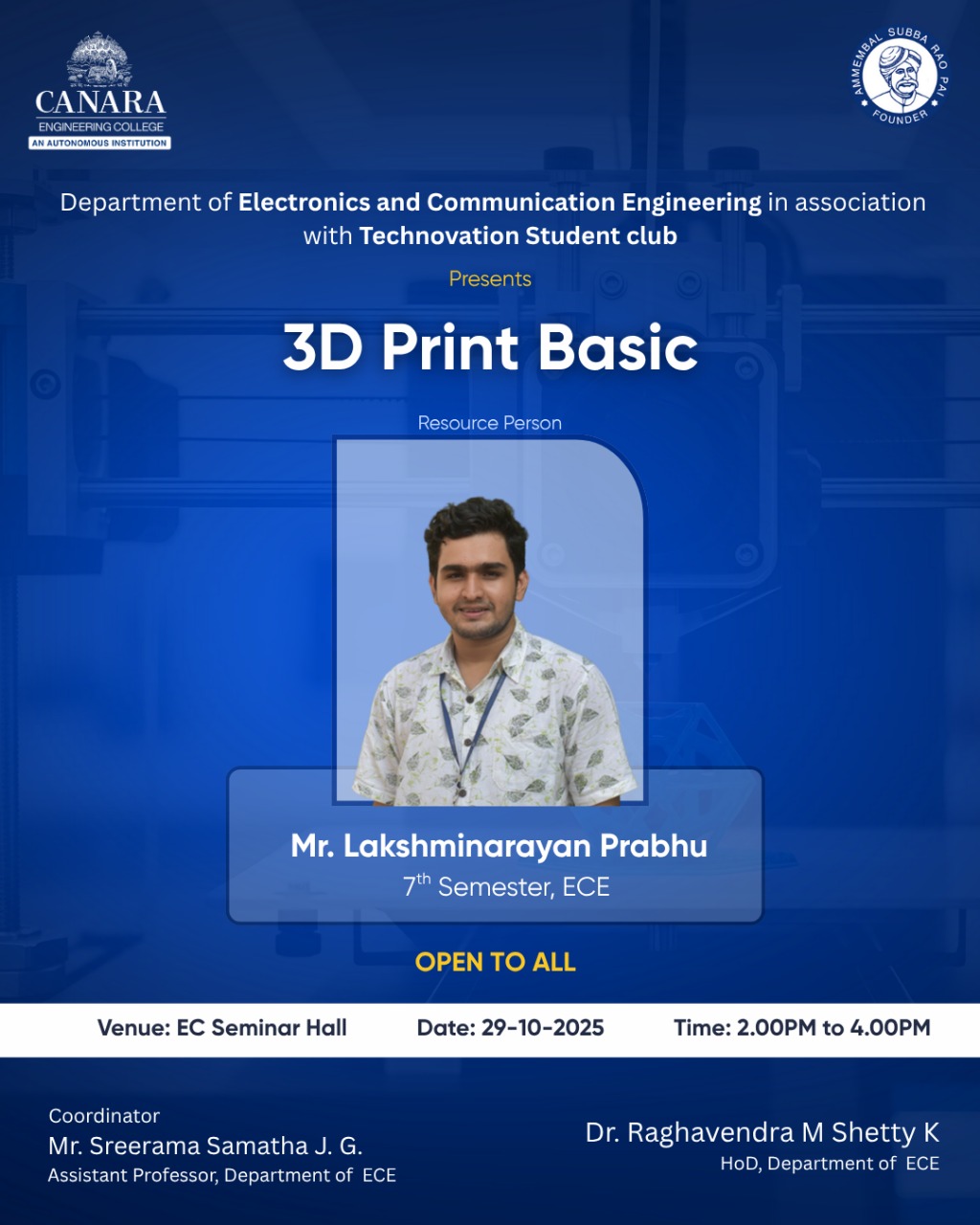
| 3D PRINT BASIC (29-10-2025) |
The Department of Electronics and Communication Engineering, in association with the Embedded/IoT Student Club, organized a workshop on “3D Print Basics” at the ECE Software Lab. Conducted by Mr. Laxmi narayan, 7th semester ECE, the session was coordinated by Mr. Sreerama Samartha J G, Assistant Professor, ECE. The workshop provided participants with foundational knowledge of 3D printing technologies, design tools, and practical demonstrations of printing procedures. Students gained exposure to the operation of 3D printers and learned how digital models are converted into tangible objects through additive processes. |

.jpeg)
.jpg)